

Housemugs website design
Client:
HouseMugs of Keypoint Signs & Graphics - Atlanta, GA
Overview:
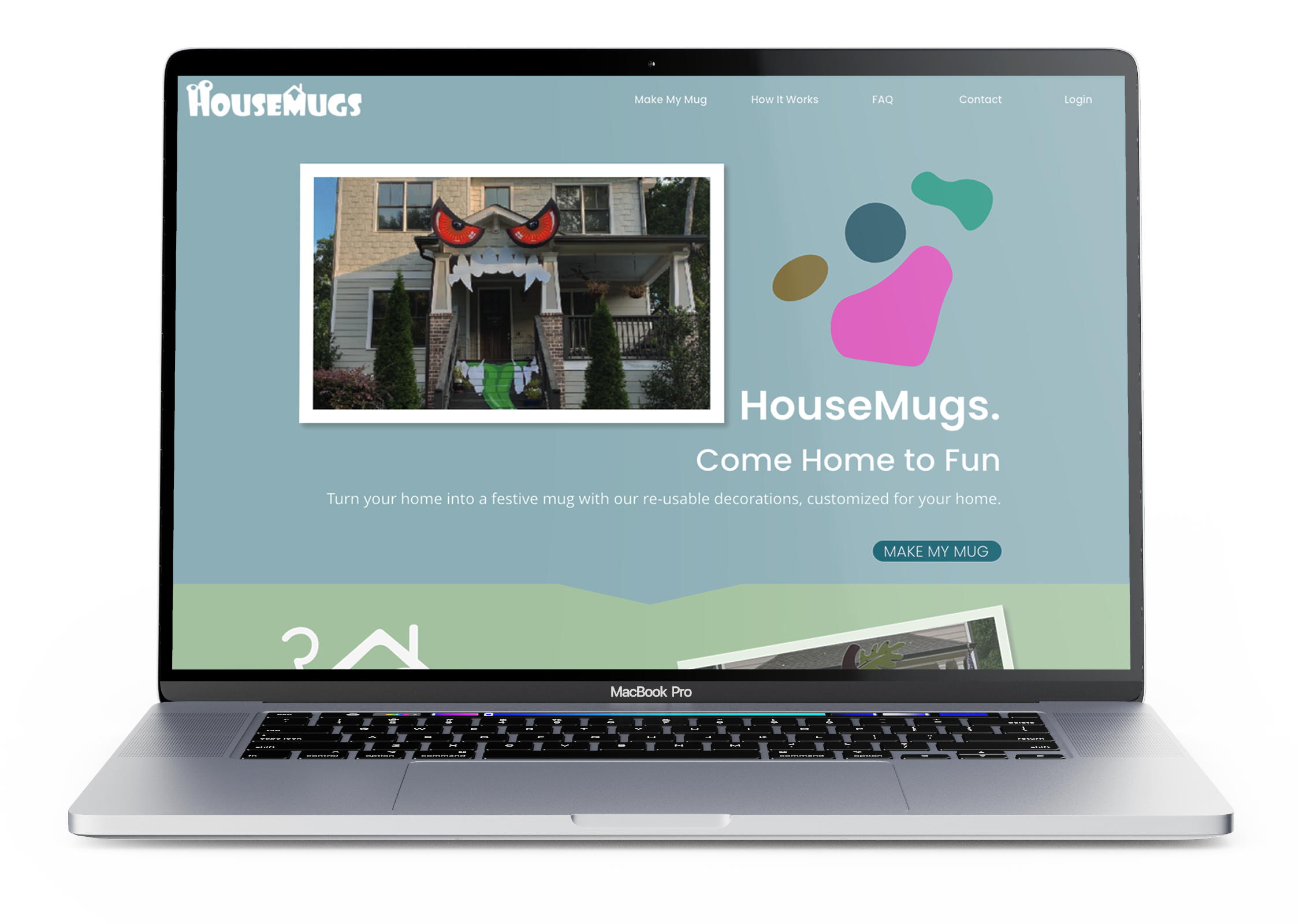
Designing a website that would allow users to customized large-scale, reusable, decorations perfectly fit for their home’s exterior. This was a 3-week design sprint team project for which we used a Lean UX process to give life to our client’s ideas by creating and testing an interface that automated the client’s product measurement and design process.
My Role & Responsibilities:
As UX Research Lead, I was tasked with ideating solutions to challenges by conducting research into other interfaces solving similar problems. I also tested the validity of our solutions through user testing and assisted in the building of our prototype.
Contributions:
Competitive research, concept ideation, research synthesis, user testing and UI wire framing, prototyping
Problem Statement
HouseMugs’ current online customization and ordering process involved a lot of back and forth between customers and HouseMugs via consultations and house visits.
HouseMugs wanted our help to design a interface that would educate the user on the client driven measurement and design process to streamline the process to save time on production and give users more freedom to bring their own designs to life.
Project Goals
We were given three tasks by our client to design a product that would put his ideas in front of users and test their success
Educate the user on the how to properly measure their home in order to have the design correctly sized for their house
Create a fun and engaging experience that the whole family could take part in to create their custom design
Create an interface that would automate the pre-production process of designing and scaling customer designs
Research Methods
This was a brand new unique company so we weren’t able to perform research with users as they didn’t yet exist. Instead, I focused on looking to interfaces that sold products with many options for customization like Redbubble, Blinds to Go and Inside Weather to inform the MVP that we built to test our ideas.
MVP testing
Testing Insights
We built a low fidelity MVP to get feedback on ideas from users.
During testing users did not understand why they needed to measure their house and how to do it with the client proposed process. As we developed our future prototypes we sought to solve this issue through adding onboarding of the full HouseMugs process on the home page and further instructions for the measuring and design features.
User Persona
After engaging having 8 users test our MVP we created a persona and identified 3 crucial needs that would help us solve our goals.
The Ultimate Soccer Dad
He wants an easy and intuitive custom design process that he and his whole family can be a part of.
He’s a busy guy and needs a process that is easy to understand and won’t take him very long to figure out.
He wants a lot of information about the product so he knows what he’s buying before he hits “purchase.”
Prototyping & testing
As we continued to iterate our customization feature we learned that we needed to split each task into clear separate tasks on different pages as to not overwhelm the users with information.
We assisted in guiding our user through the measurement and design process by adding onboarding information on the front page of the site to get them right into the designing process.
As we developed the functionality and fidelity (evolution seen below) of the site we also developed the branding fun and inviting pastels and rounder shapes.
Challenges
Initially we were working alongside a team that was developing a similar mobile product for HouseMugs; it took us a while to learn that the project would be more successful if we each approached different ideas to give more data to our client.
It was difficult to imagine an intuitive way to bring the client’s ideas around the measuring process to reality. We managed to solve the issue by including more onboarding information however we included other proposals for our client to pursue at the end of our design sprint.
lessons
Trust Your Instincts and Don’t Sugar Coat
With the pressure of tight timeline we were only able to test the preliminary ideas that our client had in mind for the pre-production measuring process. If we were to approach this project again we probably would trusted our instincts and avoided trying to develop a feature that we thought would put more work on the end of the user.
LEAN UX
This project was challenging from a research point as it was my first time doing research with a LEAN method where our greatest research tool was our MVP. It was important that as we tested MVP and prototypes that we emphasized not only on how the design functioned but also how they felt while using it.
It was also a valuable experience in working with a real client on a UX process and communicating our findings effectively to help him make decisions after our design sprint was finished.